
Connect
One API and an embedded sign-in. Your users sign in where they already sign in, the wallet opens inside your own application, and your system asks for a payment when it needs one.
Putting money inside a product is usually a year of work you did not plan for. This is the short version of what it takes instead, and what you are left running afterwards.
We scope the timeline with you. What follows is the shape of it, whichever way the dates land.
One API and an embedded sign-in. Your users sign in where they already sign in, the wallet opens inside your own application, and your system asks for a payment when it needs one.

Your wallets, your settlement accounts, your country and your currency. We set the structure up with you first, so the tiers match how your business already works.

Test mode first, against a test-mode connected application. When you are satisfied with what you see, the same integration is pointed at live.

Release what you owe, review the withdrawals in the queue and export the records for the period your finance people need. Day to day, that is the work.
Two movements carry most of the volume in a wallet. Here is each of them in order, with nothing skipped over.
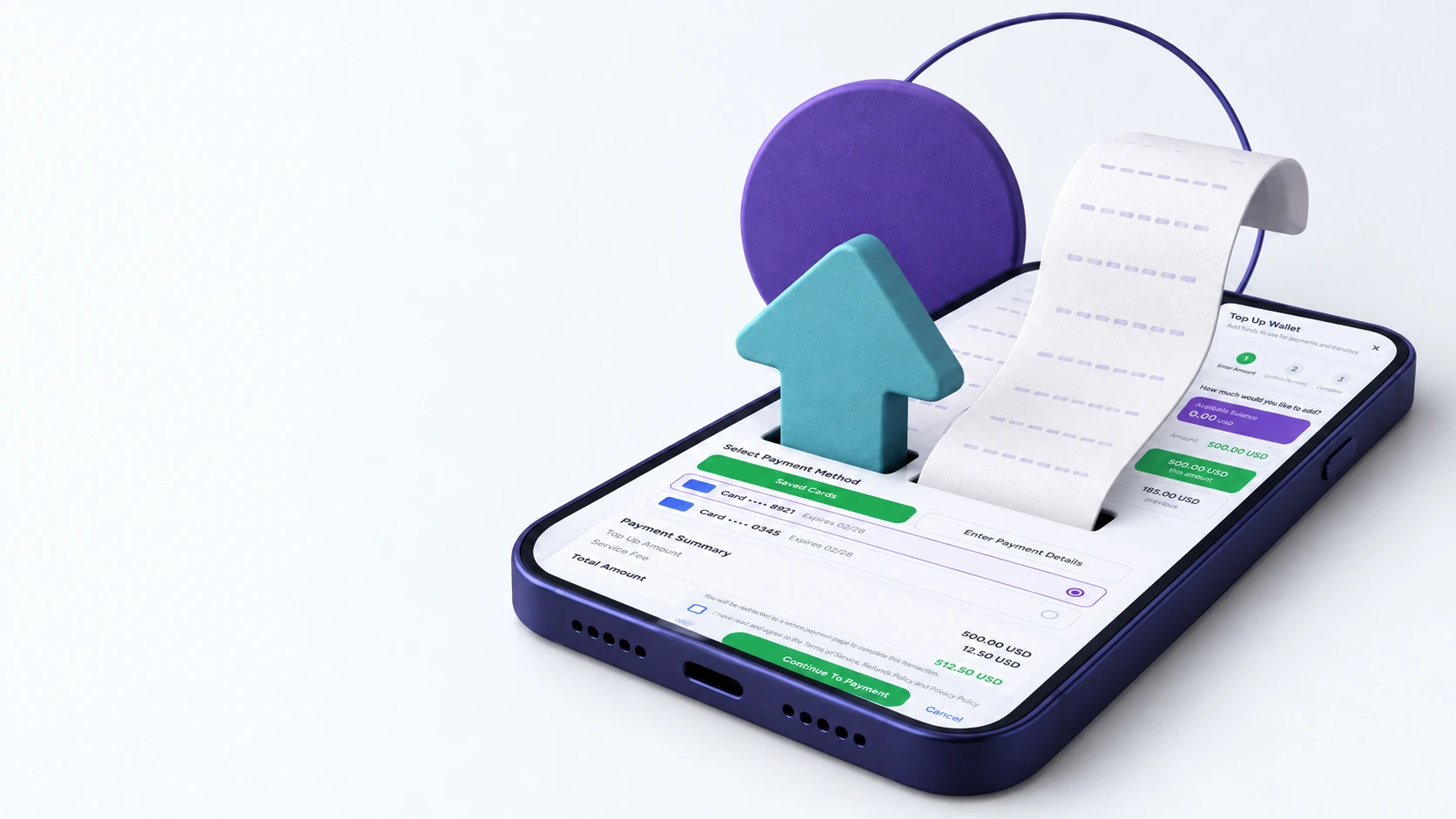
A top up starts in your product and ends as a balance your customer can spend. The card never touches us, and the balance does not move until the payment provider says the payment went through.
In the wallet, inside your own app. The Service Fee and the Total Amount are shown before they go on.
On the payment provider's own secure page. Card details never reach us and we do not hold them.
The result comes back to the wallet. Until it does, nothing in the balance changes.
The balance moves once, on confirmation, and your customer can spend it.
Every amount is recorded twice and checked. If the two sides disagree, the difference is raised rather than absorbed.
A withdrawal is the same story in reverse, with a person in the middle of it. Money does not leave on its own. Withdrawals are manually reviewed and typically processed within 1 to 3 business days.
Bank Withdrawal to their own account, or a Cash Voucher to draw as cash at an ATM.
It is held against the wallet for as long as the request is open, so the same money cannot be spent twice.
The request sits In Progress while it is checked by a named person, with the evidence kept against it.
To a bank account, or as a Cash Voucher with a PIN sent by SMS. The request is marked Completed.
The same double entry as every other movement, and the same check against itself.
Your app asks for a payment. The wallet shows who is being paid, what it is for and the Total Amount, and nothing moves until your customer confirms it.
That approval is the moment a split is applied, so the parts are allocated as the payment is made rather than reconciled out of it afterwards.
No. A wallet is not a bank account and it is not a card gateway. It is the layer that holds and moves money between the people in your product. The difference from a gateway, set out in full.
No. The wallet opens from inside your own application, and your customers sign in where they already sign in.
A person checks every withdrawal before it is released. Withdrawals are manually reviewed and typically processed within 1 to 3 business days.
No. Transfers are instant, and they cannot be reversed. That is why the wallet says so before anyone confirms one, and asks for a one-time code first.
They are entered on the payment provider's own secure page. They do not pass through our system and we do not hold them.
One currency per wallet, set when the wallet is opened. Wallets run today in ZAR, GBP, EUR and AED, and each deployment is configured for its country, currency and language.
Tell us how money moves through your product today. We will show you what the wallet takes off your hands.
