


More value stays in your ecosystem
Money that lands in a wallet is money that keeps moving between the people in your product, rather than leaving for a bank account after every step.
DigiWise puts a digital wallet inside your own app. The people who use it top up, pay, transfer and withdraw without leaving, and you see what is held, what is due and what has settled.
Your customers. Your app. Our wallet infrastructure.
A wallet is not a bank account and it is not a card gateway. It is the layer that holds and moves money between the people in your product.
Money that lands in a wallet is money that keeps moving between the people in your product, rather than leaving for a bank account after every step.

A balance is a reason to come back. Refunds, credits and rewards land where they can be spent again.

You decide what a transaction is worth to you, and take your share as it is made.

We run the wallet, the gateways, the ledger and the withdrawals. You connect your app.
Every industry is becoming an ecosystem. Customers, partners, suppliers and staff all transact around the same product, and each of those movements currently exits to a bank and comes back as a reconciliation problem.
A wallet keeps that value where it was created, and gives you one place to see it.
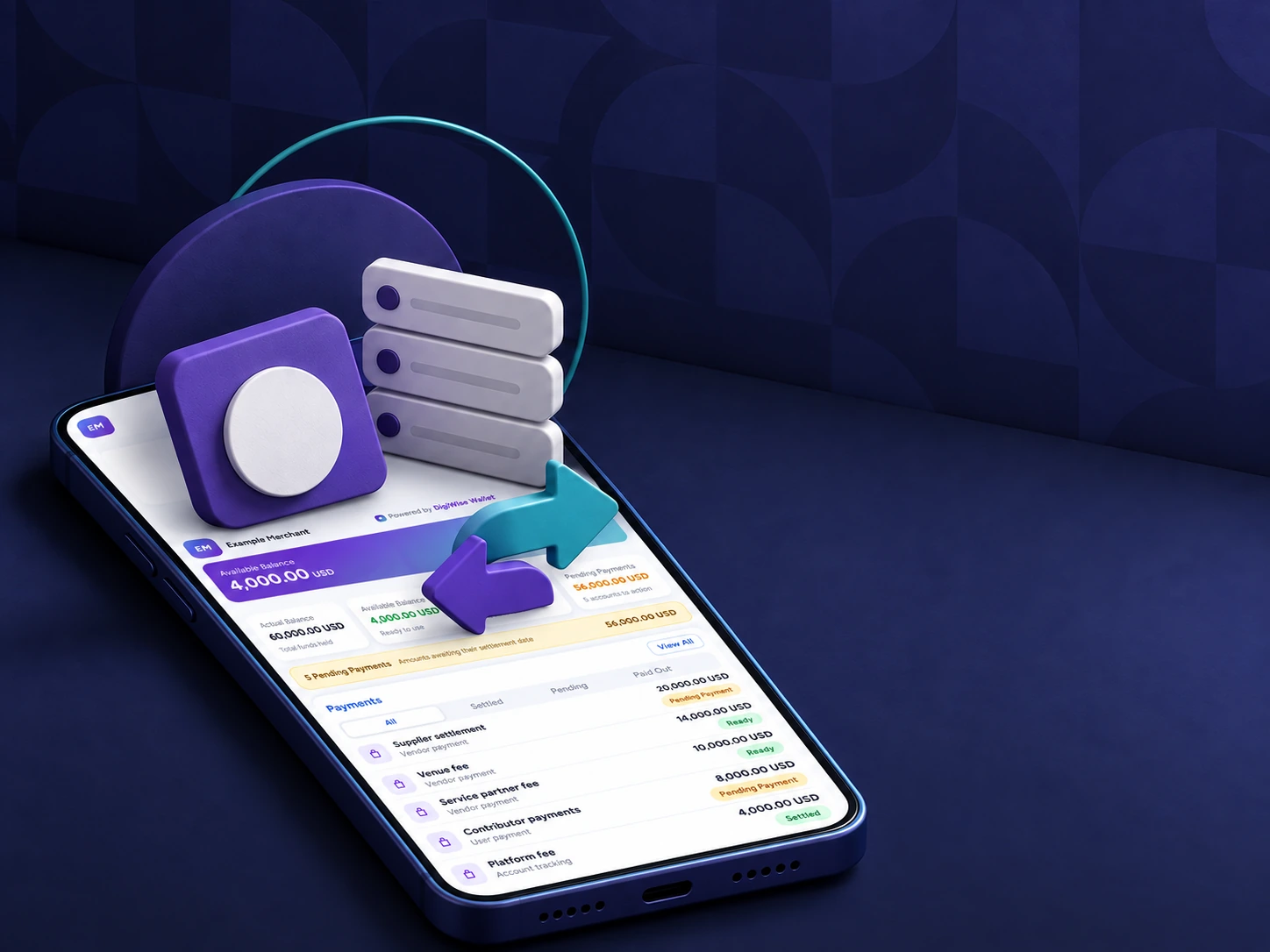
A wallet does four things. Everything your customers do is one of the four, which is what makes it quick to learn and quick to support.
The balance, this month's movement and three actions. Nothing else competes for attention.
Money is loaded from a card on the payment provider's own secure page. Card details never reach us, and the balance moves only once the provider confirms the payment.
Your app asks for a payment. Your customer approves it in the wallet, and the amount can be divided between the parties as it is made.
Wallet to wallet, with a reference. Transfers are instant, and they cannot be reversed, so the wallet says so before anyone confirms one.
To a bank account, or as cash at an ATM with a PIN sent by SMS. Withdrawals are manually reviewed and typically processed within 1 to 3 business days.
Those are the two things it gets mistaken for, and the difference between them is what decides whether a wallet is worth having in your product.

Your customers hold a balance inside your product, reached from your own app. A wallet holds one currency, and runs today in ZAR, GBP, EUR or AED.

A gateway moves money past you and on to a bank. A wallet holds it where it lands, so one payment can be divided between the parties as it is made, and the parts add up to the amount paid.

Money keeps moving between the people in your product rather than leaving after every step. When someone wants it out they withdraw, to a bank account or as cash at an ATM with a PIN sent by SMS. A person checks every withdrawal.

Every amount is recorded twice. If the two sides disagree, the difference is raised rather than absorbed, and every movement can be exported for any period.
Opened from your own system. Your team never signs in anywhere else.
Three ways to connect it. Start with the simplest and move along later.
{
  "debitWalletID": "PW_example123456",
  "amount": 200.00,
  "description": "Order 4471",
  "splits": [
    { "walletID": "MW_example123456", "amount": 160.00 },
    { "walletID": "HW_example123456", "amount": 40.00 }
  ]
}

// the wallet asks the customer to approve it
{
  "status": "authentication-required",
  "authentication": { "status": "pending" }
}
Your users sign in where they already sign in, and the wallet opens inside it.
Your app requests it, the person approves it, the money moves.
Every movement, for any period, straight into a spreadsheet.
Any business with a base of people who need to hold, move or be paid money.

Keep refunds and credits inside the business instead of sending them back to a card. Turn a loyalty balance into something a customer can actually spend.
Retail and loyalty · Hospitality and hotels · Rewards and partners · Travel and airlines · Refunds and store credit

Take one payment and divide it between seller, platform and partner as it is made, rather than reconciling it afterwards.
Marketplaces · Franchise and business-to-business networks · Property

Pay people into a wallet they already have, then let them move it to a bank account or draw it as cash at an ATM.
Workforce and human resources · Logistics and gig platforms

Collect once, hold what is promised to each party, and release it when it is due.
Education · Charities and events

When a card is used to load money, the number is entered on the payment provider's own secure page. It does not pass through our system and we do not hold it.
Each movement is written on both sides and checked against itself. If the two sides ever disagree, the difference is raised rather than absorbed.

Money does not leave automatically. A withdrawal is reviewed and evidenced by a named person before it is released.

On signing in, and again before a transfer. Tokens and sensitive data are encrypted with AES-256-GCM.

Your customers hold money with you. You see every unit held, due and paid.


